Thailand

Meditating with Thai Monks in a Forest Monastery: Wat Pa Tam Wua

One hundred people surrounded me in the dark, but the only sound I could hear was that of my own breath.

Suddenly, a low voice swam through the thick silence and saturated all four corners of the open-air forest monastery where we sat in stillness:

“Right now, there is nothing you have to do or think about.”

The Thai monk’s mellow tone echoed throughout the wall-less Dharma Hall towards the ears of dozens of visitors and volunteers from around the world.  I would hear his heavenly hum over the speaker every night but could only ever imagine the all-knowing expression that resided with it, since we kept our eyes closed throughout the routine.

“All you have to do…” he would continue with a lingering pause, “is focus on your breathing.”

As I prepared my breath to begin a forty-minute silent meditation, I savored the taste of the moment.  I felt grateful to be in a special place, at none other than Northern Thailand’s Wat Pa Tam Wua Forest Monastery (abbreviated as Wat Tam Wua), absorbing the precious Theravadan Buddhist teachings from six monks.

* * *

At Wat Tam Wua, visitors are welcome to stay for up to ten days to practice meditation in a beautiful forest setting comprised of rainbow-colored trees, streams, hidden caves and mountains.  The monastery runs solely off of donations from visitors and organizations.  Volunteers facilitate the space, organize activities, and provide visitors with accommodations plus two vegetarian meals a day.

Though I was a foreigner without a Buddhist upbringing, I felt completely comfortable during my week-long stay at Wat Tam Wua, as they welcome anyone with open arms who aspires to learn about Buddhism, meditation, or simply “become a more mindful, focused and happy human being,” as their website explains.  Check, check, check for me.

After hearing about the life-changing retreat from my hostel roommate who had attended, I researched Wat Tam Wua and concluded it was a must-do experience that aligned with my solo trip goals.  Why do we travel anyway, if not to become better people?

* * *

My mind and body dueled and danced with each other during our thrice daily meditations in the monastery Dharma Hall.  I sat in a white plastic chair (white was for women, blue for men) in the back of the holy structure that consisted of an enormous flat slabbed ceiling supported by wooden beams and glossed with ocher-brown tile floors, all encircled by forest views.

Most students plopped down on the moss green pillows in the traditional way with one leg bent over the other while meditating, but I resorted to the chair after finding this cross-legged position too difficult to hold for such long periods of time (about five hours a day).

In the daytime, the structure’s ceiling provided shade from the scorching Thai sun, as the monastery is located near Mae Hong Son near the border of Myanmar.  In the evening, the whining mosquitos joined us for meditation.

It is quite a magical feeling to close your eyes on a purple-permed night in the middle of the forest across the world, resounding in the silent presence of the sacred and the studious, with all one hundred beings inhaling and exhaling at the same vibration.

Getting There

The spiritual road is full of twists and turns.  I hopped into a minivan leaving Pai’s hippie town that swerved through wavy mountains for one hour before the van driver halted to a sudden stop, dumping me in the woods of Mae Hong Son. 

Another rider also got off the van to make the half mile walk to the entrance. She seemed less eager to chit-chat than me, which I didn’t take offense to since we were heading to a mecca for spiritual growth, not to make friends.  Plus, I knew some visitors to Wat Tam Wua choose to remain silent during their stay (you can put on a Silent pin at any time), though not required.

What struck me first were two enormous golden mountains looming above like gods looking down over us, massively disproportionate to the rest of the landscape. They were greeters beckoning us in the right direction.

What would this spur-of-the-moment visit bring?  What would I learn from the monks?  These questions captivated me.

A Spellbinding Setting

Finally, the trees parted to reveal an arched entrance above a wide sand road leading towards a village of huts by the river.  We had arrived. 

Two friendly monks in orange robes spotted our lost faces and waved us down to point us in the direction of the reception.  I was pleased we were already able to speak with the monks casually, because as women we must keep our distance out of respect.

On that note, the volunteer checking me in did mention that women must sit in the back half of the main hall for all lessons and meditations, far from the speakers.  We also had to walk behind the men during walking meditation.  The reasoning was “to not have any distractions from meditation,” which you can make your own conclusions about.  Later, these gender rules ended up being a bit inconvenient as the lessons often started before the women returned from walking meditation.  However, I didn’t let this damper my experience and I was thankful to be able to visit the monastery at all.

The kind-hearted volunteer explained a few other rules essential to showing respect.  Do not sit with your feet pointing towards Buddha; do not hug your knees into your chest when sitting (this implies boredom); all visitors must wear white clothes (these are provided if you have none); yoga is not allowed outside your kuti (poses can be provocative); be sure to arrive early to all activities.

Most importantly, all spiritual activities are mandatory, from 6:30 AM to 8:00 PM.

After checking in, I plucked a mat, blanket, and pillow along with the white uniform from the laundry shed and trotted towards the dormitory, since all the private kutis were full.

Photo by Catalina Koe

The dorm was one large room with a screen door for insects and a creaky wooden floor that could probably fit about forty mats.  During my stay, the greatest amount of people sleeping in the room at a time was near thirty.

I tossed my pack down and quickly changed into the loose lavender-tinted-white pair of sweatpants and unisex V-neck blouse, almost resembling scrubs, ready to jolt downstairs and arrive early to the mid-day food offering to the monks.

My quiet mate from the van was slugging into the dorm as I leapt out the door.   “You look like a nurse,” she smirked at me.

A Full Schedule of Activities

Our daily schedule consisted as follows, with mandatory activities in bold:

05:00 Morning meditation in your kuti.

06:30 Rice offering to the monks.

07:00 Breakfast.

08:00 Morning Dharma talk, and meditation class.

10:30 Food offering to the monks.

11:00 Lunch.

13:00 Afternoon Dharma talk and meditation class.

16:00 Cleaning the area and helping in the monastery.

17:00 Free time.

18:00 Evening Chanting, meditation and Dharma talk.

20:00 Meditation on your own, or have tea, coffee, hot chocolate & relax.

22:00 Rest time.

Rice and Food Offerings

Every morning at dawn, we knelt in darkness to participate in the age-old tradition of offering rice to the monks.  Each monk would hold an alms bowl while sauntering down the line of kneeling students, pausing in front of each student who would then scoop a spoonful of rice into the bowl.  This was the breakfast offering, as monks only eat and drink what is given to them.  Afterwards, a volunteers would bring the monks the rest of their meal to accompany the rice.
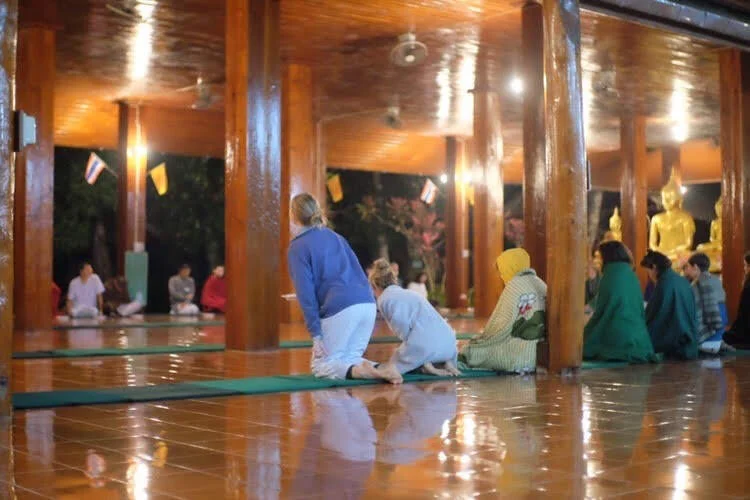
Photo by Catalina Koe

For the lunch offering, the final meal of the day, the process was slightly different.  The female students would present the various dishes to the abbot (the head monk), bowing before him and raising the soups and salads and vegetable-potato-rice-filled dishes in the air before placing them down in front of him.  The abbot would pick the dishes up with a receiving cloth (as to form a barrier between what the women had touched) and serve himself the food before passing on each dish to the male students that could offer them freely to the other monks.

The jolly light-eyed abbot would always make silly remarks that cracked me up, dissolving any seriousness at the monastery.  He would laugh at his own jokes, too.   For example, instead of instructing us plainly not to visit the dorms of the opposite gender, he would instead say “Tonight… no Thai massage!”.  When recounting the story of a student who was afraid of a snake, he would acquire a high-pitched squeal, giggling as he mimicked the student: “Help me!  Don’t kill me Mr. Snake!” as we all buzzed with chuckles.

Meals and Silent Area

For the lay-person meals (the students and volunteers), we would eat the same foods that the monks ate after they were served.  We lined up for buffet-style breakfast and lunch, the latter around 11AM.

Having our final meal at normal “brunch” hours was not as big of a problem as you would imagine, given that we were rising and going to bed early.  However, after the third ay I succumbed to my cravings and purchased snacks at the small store at Wat Tam Wua that sold items like cup of noodles, chips, some fruit, and sweets.

Why didn’t we eat dinner?  From the Buddhist books I read at the monastery such as Ajahn Sumedho’s anthologies, they explain that while us lay people often surround our days around desirable foods and celebrate feasts, monks eat consciously as a utility.  By only eating one or two simple meals a day, this limits food or other pleasures from becoming a priority over spirituality.

The dining area was split into two sections: silent and non-silent tables.  Even though I chose not to wear a silent pin, as to have the freedom to speak if I wanted to connect with people, I still found myself sitting at the silent tables every meal, reflecting.

Chanting

What some people found tiring ended up being one of my favorite activities: evening chanting.  We chanted uplifting credos in Pali, Thai, and English for forty minutes, and although I only understood the English, I treated the chants like songs, and belted them out loudly.  After all, it was our only music!

Cleaning the Monastery

Voluntary cleaning usually consisted of raking leaves or sweeping around the monastery, although we were encouraged to help out at all times, from preparing food in the kitchen to washing dishes to tidying up the common areas.  The hour gave me a chance to get some light exercise and chat with other students to find out how their meditation experiences were going.  I even got a rare chance to speak one-on-one with the abbot (though we just made small talk).

Core of the Meditations and Dharma Talks

Feel each part of the body.  It is not your body.  It is the body,” the monks instructed us during sitting meditation. “Feel!”

The monks detailed the distinction between the soul and the mind and the body — between observing and thinking and feeling.  This body is merely a vessel for us to experience during this lifetime; not the same as the soul of our being.

“Notice the mind thinking.  It is not your mind.  It is the mind.”

We shall disassociate with the mind as self.  We notice the mind’s mortal thoughts without judgment, like watching a cloud pass by.  We do not try to stop or repress the thoughts, as they will disappear on their own once we are observant.

Our soul is the knower.

These acknowledgments laid the foundations for our meditation practice.

3 Types of Meditation

Each meditation session consisted of walking, sitting and lying down meditations.

Walking meditation?  I always thought meditation was about sitting still.

Photo by Catalina Koe

We would shuffle slowly in a single file line through the forest, the utmost serene setting.  One monk would lead the line, meticulously stepping his right heel down like molasses, followed by the ball of the foot, then toes, chanting the mantra “Bud” in his head. Then, the same thing on the left side, except chanting “Dho”. You can imagine how slow we were walking.

“Bud dho” means “the one who knows,” as we become the knower: aware of our thoughts, separate from the mind, rather than letting our thoughts run like a wild horse.

The point of each calculated step was to remain focused on one object, such as the soles of your feet, the inhale and exhale of your breath, or the mantra “Bud-Dho”.  This is the essence of Samatha meditation.

Once we master Samatha, we may move into Vipassana meditation to reach a greater wisdom. Vipassana meditation involves moving the object of concentration into the background (i.e. your breath) and noticing how the mind wanders towards or away from that object, allowing the thoughts to become the foreground.  Thus, in Vipassana meditation we notice both the object and the mind at the same time.

It was challenging to stay focused while woodlands of wonder preceded us.

We strolled by gorgeous gold and purple flower petals, the sparkling river, autumn-tinted leaves, mysterious caves, and a cute Chow-mixed dog named “Bui Dog” that would follow us around the monastery.  I still think his name should be “Bud-Dhog”.

After almost an hour of walking meditation, we washed our feet and sunk back into a chair or cushion in the main hall to practice sitting meditation using the same fundamentals for another forty minutes.  Finally, we reclined on the floor for a fifteen minute lying down meditation.

We repeated this triad in the morning and afternoon, with the evening session solely consisting of the sitting meditation. 

It may sound like a lot of meditation for the beginner, but the way the sessions were broken up gave the day structure and made sense.

Personal Experience

Despite a week of studies, the greatest takeaway I left with was that truly understanding meditation comes from practice.

Each day of practice grew easier to focus and calm the mind.  While the first day or two was challenging – to sit for hours, to stay present, and to find stillness – my experience transformed into pure bliss after breaking the ice.

Still, I felt quite lost at times.  Am I doing the meditation correctly?  My mind wanders less, but I don’t feel particularly wonderful, or like I am accomplishing anything.

I decided to borrow some books on Buddhism from the monastery library to aid my practice and fill in the blanks, and ended up reading five books during my stay.  The books written by bhikkus and scholars explained concepts in depth, from the fundamental truths of Buddhism all the way to modern applications today, answering several questions I had.  Here are just a few that may be useful to your daily life:

How often should we meditate?

Working all day and doing one meditation at night is not likely going to be able to cure all our learned mental patterns.  Instead, focus on co-existing with these busy mental states throughout the day.  Be kind and patient and aware.  In other words, apply the constant practice of non-judging, non-attached loving kindness throughout the day to remain in a neutral state.

How do we get rid of negative thoughts?

Our arising thoughts and feelings are normal and should not be shut out, whether we think of them as ‘good’ or ‘bad’.  Emotions are mortal states that we cannot repress.  We simply absolve them by acknowledging them, which results in their naturally passing.  Meditation allows us to remain neutral towards these emotions.  In Buddhism, there are no mental offenses, no sins for certain thoughts, so long as we do not act upon them.

I am affected by the negative people / world around me.

We cannot control the world around us, and we suffer when we expect the world to bend to our satisfaction.  Oftentimes, we blame society or our upbringing or other folks for our problems.  It is true that other people behave in ways that are inappropriate, however we are still responsible for our own reactions and expectations. Their actions result in their own karma.  The good news for us is that when we stop clinging to an outcome, we are able to let go and accept the world as is — freeing us from desire and suffering.

If we let go of desire, how can we still be motivated to do anything?

We can still be productive individuals and achieve purpose in our lives, without heedless desires.  This comes from knowing things as they really are, through mindfulness.  When we observe with an uncontaminated mind, we achieve clarity on what we are here to do, without intrusive desires or clouded judgment.  For example, Buddha was free of desire but still remained a productive teacher. He did not become one in order to be a famous person, or to earn lots of money, or to find a wife — but because it was his calling.  Neutrality through meditation allows us to make guided choices to understand what we need to do and what we need not to do.

* * *

This unique week that I had the privilege to spend at Wat Pa Tam Wua Forest Monastery in Thailand was nothing like I expected but became everything I needed.  I am eternally grateful to the extremely patient monks that dedicate their life to teaching others, answering all our outlandish questions in multiple languages, and giving us the tools for a lifetime. I thank the volunteers who pour their hearts into the monastery yet collect their plate of food last.

On the last day, I left my donation and crammed with ten others into the bed of a rustic metal truck that skirted out the cream-colored arched entryway. I looked back at the gods on the golden mountains as the sunny waters whispered to me, goodbye.

Gallery

An assortment of Spring memories not already pictured. Click each preview to view the full image.

How I Got Stuck in the Pai-Hole: Why Thailand’s Mountain Town is Hard to Escape

“Molly… How long have you been here?”

My new wide-grinned acquaintance, a 22-year-old shirtless man living in Florida, looked up at me inquisitively as I pranced with my hula hoop on an uneven bamboo dock that was nestled by the sparkling river along the back-acre lawn of Paradise Bar.

“Umm… I don’t know, actually,” I responded carelessly, suddenly realizing I had genuinely lost of track of time during my stop in Pai, the laidback mountain town in northern Thailand near the border of Myanmar. “I think I’ve been here, maybe a couple weeks?”

We were gathered on the outskirts of the main town, enjoying a sun-kissed afternoon by the water with a couple friends, singing classic songs with a guitar-yielding traveler from France and a Brazilian mermaid who carried the voice of an angel. Everything flowed so naturally, and I frolicked my heart out on the dock, feeling deeply connected to the sky, sun, trees, water, and earth like never before.  I was barefoot with soil-stained soles, skin tanned to a crisp, unbothered by the mosquitoes and sweat of the 90-degree afternoon.  

I suppose I blended in well, feeling so at home with my surroundings, that it appeared I had been in Pai for a long time. 

“Have you ever heard of the Pai-hole?” he asked me.

I turned to look at him and paused for a moment, taking a break from flinging my hoop through the soggy air for hours, wiped the sweat off my brow, and exhaled. 

“No, I haven’t…” I replied unconvincingly, denying what I suspected what was to come.  “What is it?”

Florida was laying down on his back, peering up at the rich purple-colored sky with dazed, half-open eyes.

“The Pai-hole is what you get stuck in,” he explained dauntingly. “It’s when people come to Pai to visit for just a moment, but they end up getting sucked in.  Backpackers will travel across the world, spending a few days in each place, hopping all around Southeast Asia, the mountains, the beaches, the islands,” he continued. “But when they come to Pai… well, they forget about all the plans they had, the rest of the trips they were going to make.  They never leave.”

Shit, I thought, as I looked around at the overgrown grass, the last of the dusk light seeping into darkness. He’s right. I’ve gone complete, full dirty hippie, singing kumbaya songs to Mother Nature until the wind chill hits at night.  I haven’t talked to my folks or friends back home in at least a week.  I’ve halted all thoughts of my next buses, trains, or flights to catch, countries to visit.  I don’t even wear sunscreen or bug repellant anymore in this jungle village under the scorching South Asian sun.  I can’t walk down the streets of Pai without running into handfuls of friends and locals I know, which is always a delight.  I spend my nights parading with the circus freaks and dancing to the beat of (literal) drums.  I’m living 100% in the present moment, and I absolutely love it. 

But I wouldn’t admit it openly yet, the slightest tinge of anxiety creeping in as night fell, thinking about truly getting sucked in to this supposed black hole.  

“Nah,” I countered, starting to sway with my hoop again. “That just sounds like something people made up!”

On my right, France suddenly looked up from his guitar, even though he had stopped playing a while ago.

“It’s a real thing,” he stated matter-of-factly. “You’re already in it.”

* * *

A few days after that evening, I woke up from my Pai slumber and decided to visit the neighboring area of Mae Hong Son for a new experience, trekking even deeper in the mountains – but I will always remember the beautiful moments shared in this psychedelic village close to my heart. 

So what is it about the elusive Pai?  What makes this city so compelling?  Here are a few reasons why I believe this friendly town draws in droves of backpackers every year, making you never want to leave.

The community is full of creative artists and performers.

Do you love art, music, dance? Pai has it all.  The difference between Pai and other cities, however, is the encouragement of creative expression without any judgment.  It’s a great place to get your foot in the door, a chance to try performing in front of an audience for the first time, or to gain experience learning or teaching.  This is why Pai fosters a creative hub for aspiring artists to play without hesitation.

Open mic nights offer a space for poets, musicians, and all types of dream-weavers to share their gifts to a supportive crowd.  Fire shows and circus acts pop up at different hostels and venues every week.  Live jazz, reggae, and acoustic performances are popular staples at restaurants and bars in town.  Dance music DJs spin evening sets at open air pubs and the epic jungle parties.

In the related realm of creative spirits, Pai is a flow-centric town with yoga, acro-yoga, and ecstatic dance gatherings for all us new-age backpackers.  And as I’ve mentioned before - if you’ve never even tried it, this is the perfect place to start!

You get to know everyone in town quickly.

Being a relatively small town, with the main roads being Walking Street and Bar street, you get the opportunity to run into the same people everywhere you go, even after just a couple days of visiting.

More importantly, the chill atmosphere between locals and foreigners is more inviting and welcoming compared with the disparity in Southern Thailand as many travelers have noted. 

When it’s easy to make friends, you feel at home – even across the world.  I also stayed in several different hostels which allowed me to meet more and more people. 

Unfortunately for me and others staying in town for extended periods, I would get very close to new friends and then they would leave for other places, resulting in heartbreak every 3 days!  But they all sheepishly said the same thing: “I wish I was staying longer.”

The vibes are trippy, hippie, chill, man.

Beyond the dreadlocked backpackers and vegged-out nomads, Pai emits psychedelic vibes in its own light, not just because of the visitors!  Though it’s not the same “as it used to be years ago,” as the nature of change usually is, it’s still totally a place to trip out and take a breath.  Chill.   

Whether it’s lounging at a neon hidden hideout like Spirit Bar, whispering under the stars at Pai Yard Guesthouse, dusting in the depths of the Jungle Zone bashes, sitting in silence under the protection of the looming White Buddha, or gazing out into the orange-hilled sunset at Pai Canyon… there is a mystifying presence in the smokey air that you can’t quite put your finger on.

It’s a nature lover’s dream.

Several waterfalls rush through the corners of Pai, donating a generous dose of pools to cool off in the heat.  Hiking trails overgrown with exotic plants hug your limbs as you trek through the misty jungle.  The painted sunsets are unmatched over gentle mountains and aggressive rivers.  Cold, eerie caves with frosted formations are an hour’s drive away.  Reptiles, birds, ox, livestock and all types of insects make their home where they wish – not to mention the elephants at Elephant Camp! 

While Pai has practically all the modern amenities one could wish for, it remains a gem for nature seekers who want the best of both worlds.

The Night Market is actually fun.

Unlike other busy night markets in Asia, Pai’s Night Market is a relaxing stroll every night.  It’s a social hotspot where everyone meets up without even having to text, gulps a drink in the streets, pries for unique clothes, handicrafts, and of course, eats dinner every night!  

Indulge in avocado tea leaf salad, grilled salted-and-buttered corn, savory steamed dumplings, sweet potato and pumpkin burgers, too-big-to-bite falafel pita wraps, fresh fruit smoothies, Thai-style tacos, quirky flavors of bruschetta or flatbreads, chewy banana-nutella crepes or ‘roti’… and these are only the vegetarian options.

Ok, so maybe the globalization is getting a bit out of hand here.  But the prices are unbeatable (about $1 to $4 USD per dish for the street vendors), and it’s a tempting break from eating pad thai and fried rice for every other meal.

The longer you stay, the more hidden gems you encounter.

Staying in Pai is like reading a book: the more you read, the more into it you get.  That’s because a lot of the magic is only spread through word of mouth and therefore cannot be found from doing research online or in books.  I suppose some secrets are best to be kept.

What treasures, you might ask?  I bet I barely know a handful, compared with those who live there, but to give you a taste… A sauna attached to a dance venue.  Infinity pools stretching over the mountains.  Psychedelic mushroom shakes and farms.  Spontaneous drum circles.  Bamboo tattoo boys.  River-dwelling reiki masters.  Shamans, medicinal herbalists.  Friendly Thai mothers who invite you into their guesthouses for warm eats and sleeps, treating you more like family than a hotel guest.  Fat, furry dogs and cats brushing past your calves at every establishment.  Mind-blowing painters and woodworkers.  Outdoor wine bars with vocalists belting their souls out into the forest.  Peculiar postcard shops adorned with lovely murals and emotional quotes.  A new tribe of friends from every continent. (Ok, maybe not Antarctica).  And again, blacklight jungle parties, where you have to cross rivers and secret pathways to get there!

But we can’t give up alllll the secrets.  You’ll have to see for yourself what the love is all about.

Just don’t get stuck in the Pai-hole.

gallery

The best moments can’t truly be captured, right?

How to Get Around Pai, Thailand Without a Scooter / Motorbike

If you make it up the notoriously windy road to the secluded town of Pai in Northern Thailand, you are in for treats of serenity, scenic landscapes, and relaxing vibes.  Over 700 sharp turns up the mountain from Chiang Mai, this laidback “backpacker’s paradise” is far from urban life, which is the reason why we go, right?

However, the secluded nature of the spread-out village can be a disadvantage if you do not have a way to get around.  There is no Grab / Uber taxi up in the mountains; you’re on your own, baby!

While experienced bikers will opt for a motorbike / scooter / whatever you would like to call it, I chose not to ride one in Asia.  Many people asked me why, claiming that having one is the only way to get around.  This is not the case, as I have gone everywhere that I wanted to go throughout my trip thus far without a motorbike, including my near 3-week stay in Pai.

The obvious reason I chose not to ride a motorbike was due to meeting many travelers who got in accidents – some surviving with a few scratches, others breaking bones, and one friend of a friend even died (in another part of Southeast Asia). 

Not only do I possess no motorbike experience, but Thailand drivers drive on the left-hand side, sometimes dangerously.  Plus, if you want to drink alcohol you do not want to be stuck with a scooter.  In addition to the pitfalls of accidents, I also dodged rental fees and parking fees.

Yes, I am sure that if I rented a motorbike, I would probably be fine – especially with my crazy L.A. driving skills – but I chose not to take the risk because I didn’t need to!  Here are all the options concerning how you can get around without a motorbike in Pai.

Walk.

If you are a traveler, you must like walking, right?  Not only does strolling have an obvious benefit of exercise, but you also see much more on foot that you miss on a vehicle.  You catch glimpses of wildlife, encounter local culture, and run into other travelers – taking you on unexpected adventures or chances for photo opportunities. 

But of course, you are trying to get to the main attractions!  Specifically, we walked to the Night Market, the White Buddha, Mae Yen Waterfalls, and all the main restaurants, shops and friend’s hostels.  I even walked to Paradise Backpackers for the fire show, or Pai Circus Hostel for their jams, both of which are out in the boonies.  Come on, you’re in Pai, the views are beautiful!    

Even when I stayed in Pai Yard Guesthouse, one mile from the main street, I still walked everywhere.  You know, the doctor recommends 10,000 steps a day, and I was in no rush… yes, even up a steep hill under the blazing sun (Now I’m just showing off).

Unless you are staying more than 2 miles from town, my top recommendation is to walk.

Ride on the back of a friend’s scooter.

For excursions on the perimeter of Pai, such as the Mor Paeng Waterfalls, Pai Canyon, Bamboo Bridge, Chinese Village or Memorial Bridge, you will have no trouble meeting friends at a hostel that are going to these spots just minutes away – and motorbikes fit two people!  Just offer to split gas and parking, and make sure they know how to ride with a passenger.

If you truly don’t meet anyone with a scooter, or want to head to the farther attractions, see my next bullet point.

Take a tour.

If you’re short on time, a tour is a convenient, affordable way to see all the top attractions in one day and includes all entrance fees. The mystical Lod Cave takes an hour to get to and is usually combined with a trip to the Sai Ngam Hot Springs, along with most of the locations mentioned above.

Other active adventures you can book include jungle trekking, river tubing, and days at the Elephant Camp!

You can book tours on Walking Street, but I found that each hostel often had access to slightly better hooked-up prices.

Use accommodation services.

Did you know that many hostels, businesses, and restaurants that are outside the main area of town will pick you up for free?  Yes, even restaurants!  These locations understand that they are located far from the center and are usually just a Whatsapp call away. 

Whether you are trying to dine at a wine bar, stretch at a yoga class, or just put your bags down at your hotel, send the business a message online if they are not within walking distance and ask if they will pick you up.

Rent a bicycle.

See the sights with a good old-fashioned bicycle.  Choose an accommodation that has one for rent, or find a two-wheeler in town for dirt cheap.  Of course, riding a bicycle would be a quick alternative to walking, not for daring missions around the landscape of Mae Hong Son, but it will allow you to visit friends, run errands, and hit spots like Bar Street or Mae Yen area in no time, just to name a few.

Hail a taxi – only when you need to.

The only time I had a real taxi car was when I arrived in Pai off the 3-hour van ride with two heavy bags and my hostel was miles away in the unforgiving, 100-degree sun.  It was “expensive” ($2.50 USD) but I just wanted to get there after that nauseating journey.

But be aware, “taxis” usually consist of a metal crate attached to the side of a motorbike.  You may feel like cattle, but it will get you to your destination if you hold on tight aboard the hills! 

Taxis are sparse and can start to add up if you need the driver to wait for you at each location for the return trip.  If you have 2 or 3 people it may be worth it for a taxi that can be booked on Walking Street, but you never really know if you are being picked up in the cattle car, on the back of a motorbike, or in a real van.  There are also the open trucks with benches in the back that appear, that usually charge a flat rate per person.  These are often uncomfortable methods of transportation and you have to hang on to steel bars so that you don’t fall out along zig zag roads – but hey, these clunkers will get you to the jungle parties!

In Closing…

Don’t worry – if you have your heart set on getting somewhere, you will find a way.  Heck, I even hitchhiked around Pai; easier for a solo traveler to hop on the back of a motorbike.  Not saying you can trust everyone, but you will know the moments when everyone is going the same direction, like down the single road to the fire show.  Just know that despite what everyone will tell you, you don’t need a motorbike to get around the wonderous world called Pai!

Gallery

Featuring photos from my article: “How I Got Stuck in the Pai-Hole: Why Thailand’s Mountain Town is Hard to Escape

What I Wish I Knew Before Visiting Doi Suthep, Thailand

If you are visiting Chiang Mai, Thailand’s second largest city to Bangkok, you will most likely pay a visit to the gold temple on the hill: Wat Phrathat Doi Suthep, and the surrounding area.  However, before you go blindly visit the sacred site like I did, take heed of these tips to make your day efficient. 

I had a fantastic time regardless, with the dripping-gold monuments almost blinding me, and the views I will truly never forget.

Doi Suthep is the name of the mountain, not the temple.

This one was a rookie mistake on my part, but it resulted in unexpected beautiful scenery, so I can’t complain. 

If you search “Doi Suthep” in your GPS, you will end up driving for a while up windy roads in the forest.  When we got to a one-way road, we started to grow suspicious.  Finally, Google Maps told us, “You have arrived!” in the middle of the forest. 

Although Doi Suthep is the colloquial abbreviation that everyone uses when discussing the landmark, the full name of the temple is Wat Phrathat Doi Suthep.  The error sent us about 30 minutes past the real location, but the cool breeze up in the mountains and gorgeous sun rays peaking through the trees was a refreshing break from the hot and dry city level anyhow.

Doi Suthep mountain is 5,500 feet (1,676 meters) high and looks over Chiang Mai.

The dress code at Bhubing Palace is extraordinarily formal.

If you have entered temples before, you know the basics of covering your knees, shoulders, and taking off your shoes.  But Bhubing Palace, the next stop down the road for many travelers, has a notoriously formal dress code.

Both men and women must wear thick clothing (my top was deemed too see-through) that basically goes down to the ankles, with tops that have longer sleeves.  Most people in 90 degree heat are not walking around covered head to toe, so fortunately there are shops outside the palace that rents clothing for a price equivalent to $1 USD per clothing item, plus a deposit. 

However, you might not get to choose your outfit, with resulted in this garish colored garb I was stuck to parade around with!

Half of the year, you cannot even enter the Palace. But they will still sell you a ticket.

After succumbing to the elegant traditional wardrobe (love the style; I just didn’t prefer the colors), we bought tickets to Bhubing Palace for around $3 USD each, only to walk around the grounds and find out - along with other confused foreigners - that we were only allowed to see the royal gardens.

The palace is the royal winter residence of the Thai Royal Family.  Therefore, during the winter months, you cannot enter the enticing palace, but you may view the many acres of exotic flowers and plants, charismatic trees, sparkling reservoir, and sloping hillsides, which I admit were quite impressive.  I only wish that the ticket office let us know before purchasing tickets.

If anyone asks, I had the best time. Remember, "whoever defames, insults or threatens the King, the Queen, the Heir-apparent or the Regent, shall be punished with imprisonment of three to fifteen years."

Epic waterfalls are near the temple; you can see one the same day.

Save on transportation costs and swim at gushing waterfalls near Doi Suthep in the same day.  I wish I visited one of these when I made the 40-minute trip to Doi Suthep, but ended up checking them out on different days.

The following waterfalls are near the Doi Suthep area west of Chiang Mai, and you will only need a couple hours at each one: 

Mae Sa Waterfall – 10 levels of pools, with swimming and plenty of room to picnic.

Monthathan Waterfall – located inside Doi Suthep-Pui National Park with a swimming hole and multiple levels.

Huay Kaew Waterfall – Short walking trail in a picturesque setting, but usually only flowing during rainy season or right after.

Mae Sa waterfall has 10 levels of swimming pools. Shh… the top one is the best.

There are often police checkpoints on the way to Doi Suthep, checking for your international driver’s license.

Being a popular tourist attraction, you are likely to hit a checkpoint leaving Chiang Mai if you are driving.  If you don’t have an international license, the fine will be about $15 USD.  They pull you over, charge the fine, and you are on your way in a minute, so it’s not a huge deal.  I believe after this ticket, you can drive for another 3 days before being fined again, but no guarantees with Thai police.

Wat Phrathat Doi Suthep’s gold-latent interior, breathtaking views, and new construction is indeed stunning.

Is the famous temple worth the hype?  In my opinion, yes!  Though we had visited many, many, many other temples in Southeast Asia, this one is close to the city and definitely worth visiting if you are in Chiang Mai.

…Just get ready for the gargantuan, exhausting staircase to get to the top.  

Happy travels!

Gallery

My Favorite Things to Do Near Chiang Mai, Thailand

When planning my trip to Thailand, I had heard so much hype surrounding Chiang Mai and couldn’t wait to arrive in the Old City in the north. 

However, as with any big city, I was a bit lost upon landing.  What are the true highlights worth visiting, and what is simply a tourist trap? What is it that gives Chiang Mai its character?  Is it all about the Old City Square, or is it necessary to venture outside of the main town? 

What we discovered in this blazing hot urban hub was a little bit of both worlds: there are treasures within the popular center of town, but it is also essential to embark on a quest to the surrounding areas of Chiang Mai to grasp the full experience.

The modern new town is creative, full of rich art and music with a youthful flavor, juxtaposed with scattered remnants of old city temples and monuments.  Beyond the center, you will want to take day trips to discover national parks, waterfalls, elephant sanctuaries, mountains, and more.

Note: it is not necessary to stay in the higher-priced accommodations within the tourist-filled square; you can easily stay outside the river perimeter and simply walk everywhere for a more relaxed visit.

Though I am sure this list is equivalent to one drop of spice in a bowl of Tom Yum, here are my favorite things to do in Chiang Mai!

Visit the elephant sanctuaries.

Spending time with elephants was one of my two favorite days I spent near Chiang Mai.  It was a rewarding experience I will remember for the rest of my life.

We participated in Elephant Delight Project, which was run by Elephant Nature Park, one of the top ethical elephant sanctuaries in Thailand.  Rather than just visit the nature park with dozens of elephants, we opted for the project because it gave us the opportunity to spend time with a select few elephants in their natural habitat. We hiked with four elephants through the mountains, prepared their food and fed them, and bathed the mud off their backs in the river.

Each of these adorable elephants carried a majestic presence.  Females ranging in all ages, some were sweet, some were sassy, and all were so lovable.  They portrayed a silent power, a captivating aura that humbled me and felt close to them.  The mighty way they strolled, the slow movements, and their welcoming nature left me in a sense of awe that lasted all the way home, long after we had left.  In short, I truly missed them after feeling that closeness to these beautiful beings.

The entire day’s cost, which included pickup from our hotel in Chiang Mai and lunch, was about $80 USD.  If you are traveling on a budget… you should still, 100% choose to make this your splurge.  It was completely worth it.  After all, what are we traveling for other than life-changing moments like these?  Just make sure your sanctuary is a no-riding, ethical sanctuary.

Climb Sticky Waterfalls.

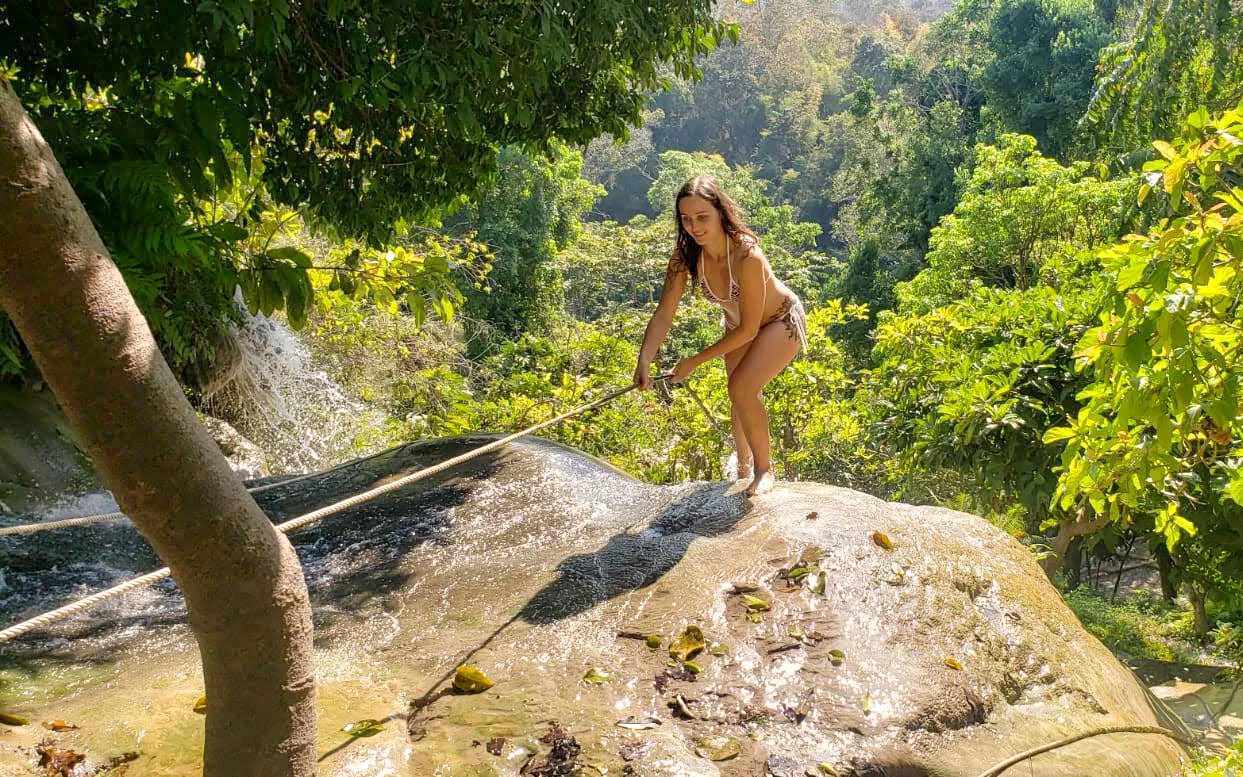
Other than the elephant sanctuary, my next favorite day in Chiang Mai was spent at Bua Tong Waterfalls, also known as Sticky Waterfalls.  The name references the strong grip of the rocks, so sticky that you can walk up and down them.  Just be careful not to step on the green rocks, as those are the slippery ones.  Ropes will guide you and give you balance while the water rushes down, cooling you off in the heat.

Photo by Khuong Tran

About three levels of rapids run from top to bottom, giving you a fun challenge.  Enjoy the pools at the bottom of each waterfall and take those epic pictures that make the falls look scarier than they are.  (I mean, it’s safe even for kids, but I’ll admit I was glad that I had travel health insurance!).

To get to Bua Tong Waterfalls, you must drive about 75 minutes north from the city center, but it is certainly worth the excursion.

Eat, drink, and enjoy performances at the night markets.

Unlike the previous bullet points, the rest of the list are things you can do in the city center that require no travel besides your own two feet.

Chiang Mai is the absolute queen of night markets.  There are different night markets on certain days of the week, like the Saturday walking street (Wua Lia) or Sunday walking street (Tha Pae), but there are also staples that run every night.  Not only is the quantity of markets impressive, but the size of each are massive.  They are never-ending streets that practically stretch across the city.

What creates the allure of the markets?  Besides shopping for everything under the sun (tchotchkes, art, hand goods, ceramics, jewelry, mementos, watches, leather, silks, boatloads of clothing)…  you can savor cheap food, guzzle down drinks, enjoy live entertainment and meet up with everyone in town.  Dumplings, curry, sweet noodles, exotic fruit, fried insects, yum. It is a grand affair every night, especially the weekend markets, though it does get overly crowded in parts.

My favorite market is the biggest, yet most low-key as it is outside the city center: Anusaran Market, on the South East side.  Most tourists do not make it out this far off the beaten path.  I like how it is a more relaxed experience with more locals and lots of space.  A high-ceiling tent with well-lit booths stretches to the back for what seems like a mile, or 2 kilometers!  Plus, you can catch a Muay Thai fight, Lady Boy Caberet Show, or rock out to the bands at the bars.

Listen to live music.

Speaking of live entertainment, the night markets are full of musicians that play blues, rock, jazz, reggae, country, classics… we heard a lot of Western music. 

For a more intimate experience, check out the North Gate Jazz Co-Op.  The tiny bar belts out live music every night after 7pm in an open-air venue on the street.  Besides jazz, the acts play an eclectic mix, like jam bands or rock.  I was digging it, and it’s a mellow place to visit alone.

The Roots, Rock, Reggae bar, a chilled spot wedged between the crazy wild dance floors at Zoe in Yellow square, brings groovy reggae acts to the elevated stage.  I was impressed by the talent in this diverse town that transported me to other worlds each night.

Discover edgy street art.

Around narrow corners and alleys are bright street murals with powerful messages.  Growing up in Los Angeles, I have seen a lot of graffiti - but none possessed quite the positive vibe I witnessed in Chiang Mai.

Photo by Khuong Tran

Lots of creatures, animals, and artistic themes characterized the street art, just down the way from ancient temples and ruins.  This new wave generation of tattooed Thai culture glared deep colors along the walls in contrast with the old city history throughout the city.

Get a Thai massage.

Come on, would the list be complete without a traditional Thai massage?  The truth is, you will do a lot of walking during your travels, and the yoga-style massages will give you a deep stretch for around $5. The first time I got a massage in Chiang Mai, I returned the next day for another! 

I usually pick a studio that has decent reviews online, but I have also just walked in and been lucky to receive a nice massage.  There is also a massage place run by women that are ex-prisoners, as it is difficult for them to get a job in society after doing time.  I stumbled across it by accident, on the north east corner of old square, and it was fantastic!  She was a strong one, so don’t be afraid to give your preference on soft or hard.

Tipping is not required, but I always give a donation to the massage therapists as it is a nice gesture, and the service is much cheaper than in the Western World for the same amount of effort.

Wander into quiet, unforeseen temples.

In Chiang Mai’s Old City, gold and white Buddhist temples hide on almost every street.  I had a more memorable experience in these unprecedented visits, contrasted with the most popular temples that charge fees to enter with crowds of people roaming in and out.

While we tried to navigate the streets to find the ancient ruins of Wat Chedi Luang (which is not hard to find, but we had just stepped off the plane), we would instead accidentally walk into smaller local temples with no one else inside besides monks watering the gardens. 

These quiet temples felt the most sacred to me, as I could feel the tranquil energy and admire the intricate holy sites with glimmering red jewels and monuments, making sure to honor the space.  Sometimes, the best kept secrets are along the roads less traveled by.   
Attend holiday celebrations.

The perfect way to end my experience in Chiang Mai was at the Flower Festival, a 4-day extravaganza of colorful flowers and events throughout the parks and streets. 

Friday brought dazzling lights around each of the four city gates: North, South, East, and West. The parade on Saturday morning was the main spectacle, with floats, marching bands, dancers, lady boys, and beauty queens strolling around the river.  The grandest array of flowers was at Buak Hard park, where droves of people flocked to take photos among the roses and wildflowers of every type.

Try to visit Chiang Mai during the holiday season for a cheerful time.  You can also visit during Songkran, Thai New Years, where everyone sprays each other with water for an entire week mid-April.  Time to start planning a trip for next year!


Gallery